Denied because of a screening report? The company that scored you owes you a free copy.
A company you never hired wrote a report about you, and the company that turned you down will not tell you what was in it.
You have three rights with dates attached, and one number that tells you which of them is worth using: 10,333 complaints against six screening companies in twelve months, and not one closed with relief.
Your FCRA deadlines, from your own date
The clocks are fixed: 60 days from the adverse action to request your free report copy, then 30 days for the screening company to conclude a dispute investigation — 45 days if you send additional information while it is running. Put the date on your denial letter in and get the actual dates.
Runs entirely in your browser — the date is never sent to us and never stored. General information based on FCRA consumer rights as explained in FTC and CFPB guidance, checked 2026-09-06. Your denial letter and the agencies' own pages govern your case.
“A lot of the information in the background check does not apply to me. You have the wrong James Taylor.”
We hear this most. a public complaint about Checkr, PissedConsumer, August 21, 2026 — from someone in the same position.
Behind an apartment denial, a failed background check or a refused bank account sits a screening company you have never heard of, and a report you have never seen. Here is the clock your letter is required to mention, in plain English: 60 days to ask that company for a free copy of the report, then 30 days for them to investigate anything you dispute — 45 days if you send more evidence while they are working.
The thing that moves this is the clock, not the complaint.
You are not alone, and this is the measured version of that sentence. In a full scan of 28.4 million rows of the federal CFPB complaint database, 31,306 complaint narratives about these companies say the record was not the writer's own. The report and the dispute both cost $0.
Denied recently? Start here →What is on this site, in one paragraph
Everything here is free, and it stays free. Put the date from your denial letter into the deadline calculator and get your own dates. Not sure who screened you? The three-question identifier narrows it, in your browser, without sending us anything.
There is nothing to buy. No account, no card, no paywall anywhere on this site. One page — Keep the Job — has a single email box asking whether a paid assembly packet should ever be built. That packet does not exist, and the method it would assemble is written out free on the same page either way.
By the end of this page you will know which company holds your file, what they owe you, and by when.
What to do tonight
- Find the company name on your denial letter. It has to be there — whoever turned you down is required to say a report was used and to name who supplied it. If they said nothing, email or write tonight and ask. That is a legal requirement of theirs, not a favor to you.
- Ask that company for your free copy of the report. One short paragraph is enough, and every situation page here has a copy-paste version. Not the leasing office's summary — the actual report they bought.
- Write the 60-day date on the letter itself. Then, the day the report arrives, read it line by line against your own records and dispute anything wrong in writing, with copies attached.
Nothing in those three steps costs money. Anyone charging you to do them is selling you a letter you could write yourself.
Free, and it stays free. Nothing here sits behind a payment, an account, or a form — and we never ask for your name, your Social Security number, or your case. The tools here run entirely in your browser; we never see your answers.
Full-text scan of the federal CFPB Consumer Complaint Database bulk file, checked 2026-09-06. Text mentions in complaint narratives, not official per-company tallies — a relative signal of where people report problems. Every company, side by side →
CFPB published complaint narratives, 2011 - August 14, 2026. The CFPB ceased discretionary publication of complaint narratives on August 14, 2026, so every narrative-derived count on this site is a closed series and will not change. Complaint intake continues, and the per-company outcome table runs on all complaints and is current.
The one number that tells you which route is worth your evening
Here is the one number that tells you which route is worth your evening. 10,333 complaints about six specialty screening companies reached the federal regulator in twelve months, and not one of them was closed with any relief for the person who complained. Over the same twelve months, on the same regulator, Equifax closed 46% of the complaints it closed with relief and TransUnion 42%. So a complaint to the regulator is not the thing that moves this. The clock is, and the clock is in the statute.
"Closed with explanation" is a response category, not a finding that the consumer was wrong. Relief rates here are complaints closed with relief divided by complaints closed; complaints still in progress and untimely responses are not closures.
CFPB Consumer Complaint Database, company_response aggregation on the CFPB's own case-sensitive company= filter, 12 months to 2026-09-08, checked 2026-09-09.
Right 1 — You must be told who screened you
If a landlord, employer, or bank takes adverse action (denies you, or offers worse terms) because of a consumer report — the file a screening company sells about you — they're required to tell you and identify the company that supplied it. If your denial came with no explanation — ask, in writing. The notice is your starting point.
Right 2 — The report itself, free
After an adverse action, you're entitled to a free copy of the report from the screening company (federal law: request it within 60 days). Not the landlord's summary — the actual report. Errors hide in reports nobody requests: other people's evictions, paid debts still showing, dismissed cases still reported as if you lost.
Right 3 — Dispute, and they must investigate
Dispute an inaccurate item and the screening company is generally required to investigate — typically within 30 days — and correct or delete what can't be verified. In writing, with your evidence attached. It's free, and it's the same mechanism whether the error is an eviction that isn't yours or a collection you paid years ago.
What disputes can't do — and we won't help with
Disputes fix errors: records that aren't yours, debts you paid, cases that were dismissed. They do not erase history that's true — a screening company verifies accurate records and they stay. If the eviction or debt is real, disputing isn't the path, and nothing on this site will pretend otherwise. What actually helps: settling and documenting it, second-chance rental programs, and time. We built this site for honest people hit by wrong records — that is who this site is for.
The data: who gets complained about
We scanned all 28.4 million rows of the federal CFPB Consumer Complaint Database for the companies behind rental, employment, and banking denials — LexisNexis alone draws 70,462 complaint mentions, a third of them (33%) "that record isn't mine." See every company, its error patterns, and how to get your file free:
Find your exact situation
Eviction that isn't yours · dismissed case still showing · paid debt reported open · denied with no reason given · background check killed the job · bank account refused · someone else's criminal record · "score too low":
Which company ran your check — and who stopped you
Two different questions, and they have two different answers. The screening company wrote the report; the employer or platform made the decision. Start with whichever one you know:
A check that is running, or has just come back: How long a background check takes · The Checkr candidate portal · Who can actually fix it.
An employer or platform that has stopped you: Uber background check · DoorDash background check · Instacart background check · Amazon background check · Walmart background check · FedEx background check.
Not sure who screened you at all? The three-question identifier narrows it in your browser, and every company we publish has its dispute route read from its own pages and dated.
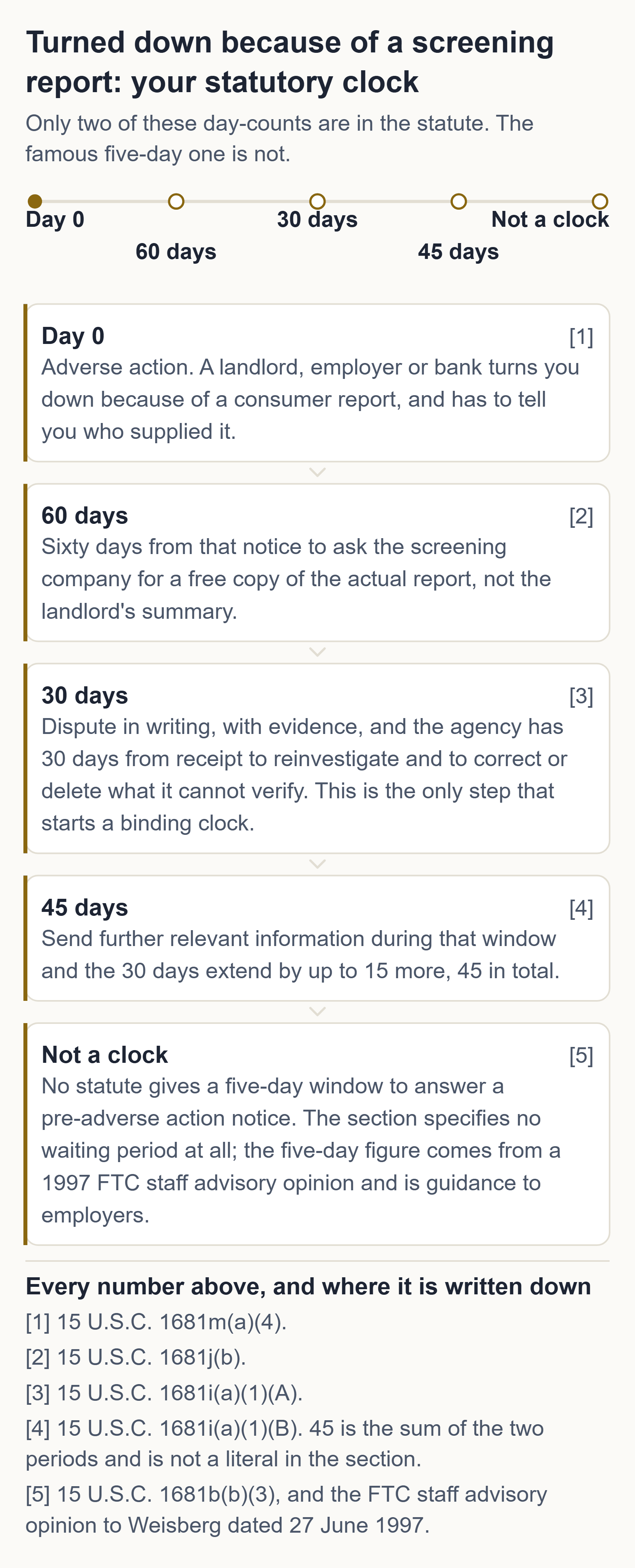
What happens next, day by day
| When | What happens | Whose move |
|---|---|---|
| Day 0 | Adverse action — you are denied, or offered worse terms, because of a consumer report. You must be told this happened and told which company supplied the report. | The landlord, employer or bank |
| Days 0–60 | Request your free copy of that report from the screening company. Federal law says within 60 days of the adverse action. It is the actual report, not the landlord's summary. | You |
| Day X | Read it line by line against your own records and dispute every inaccurate item in writing, with copies of your evidence attached. The dispute is free. | You |
| +30 days | The screening company is generally required to investigate and to correct or delete what it cannot verify. Typically 30 days from receiving your dispute. | The screening company |
| +45 days | The same, extended, where you supplied additional information during the investigation. | The screening company |
| After | If they verify something you know is wrong: add a statement of dispute to your file, complain free to the CFPB at consumerfinance.gov (companies must respond), and to your state attorney general. | You |
Every step above is free. Anyone charging you to exercise these rights is selling you a letter you can write yourself.
Where these dates come from, so you can check them yourself rather than take our word for it. 15 U.S.C. §1681j is the free-copy section: it gives you the report without charge if you ask within 60 days of the adverse-action notice, and one free file disclosure every 12 months besides. 15 U.S.C. §1681i is the dispute section: the screening company gets 30 days to reinvestigate, extended by up to 15 further days — 45 days in total — if you send relevant information while it is running. 15 U.S.C. §1681m is the notice section: the adverse-action notice you were sent is required to include an indication of that 60-day period. Plain-English versions of the same rules: FTC, free credit reports and FTC, disputing errors on your credit report.
Don't know which company screened you? Answer three questions — runs in your browser, we never see your answers.
Deactivated by a gig platform over a background check?
Income stops overnight, the platform points at the screening company, and the law gives that company 30 days to investigate. The fix is two letters on the same day, not one — and the second one, the request to hold the decision, is the one that gets left out. The full sequence, the evidence by error type, and which deadlines are actually real:
I want to be straight about what this site is. It is not a service and there is nothing here to buy. Everything on it — the report, the dispute, the letters, the deadline calculator — is something federal law already gives you for free, written out plainly because the official pages are correct and almost unreadable at eleven at night. If a record on your report is genuinely yours, nothing here will make it disappear, and I would rather tell you that on the first screen than take your money. If it is not yours, you can fix this, and the fix is a letter.
— Andrew at Axion Labs. Write to me at hello@getaxionlabs.com if a page here is wrong or a step does not work. I read that inbox.Based on the US Fair Credit Reporting Act as explained in FTC and CFPB consumer guidance, checked August 2026. This is general information, not legal advice; your denial letter and the agencies' official pages govern your case. Free help: your state attorney general, and complaints at consumerfinance.gov.
Thank you. That goes straight to the person who writes these pages.
That didn't send — try once more.