Your FCRA deadlines, from the date on your letter
Three clocks start the day you are turned down.
Every one of them costs $0.
Your FCRA deadlines, from your own date
The clocks are fixed: 60 days from the adverse action to request your free report copy, then 30 days for the screening company to conclude a dispute investigation — 45 days if you send additional information while it is running. Put the date on your denial letter in and get the actual dates.
Runs entirely in your browser — the date is never sent to us and never stored. General information based on FCRA consumer rights as explained in FTC and CFPB guidance. Sources re-checked September 28, 2026: 9 of 9 unchanged. Your denial letter and the agencies' own pages govern your case.
“She was told a dispute would take 30 days. Her rent was due January 1.”
We hear this most. Atlanta News First, reporting one applicant's timeline, February 5, 2026 — from someone in the same position — reported, not the person's own words.
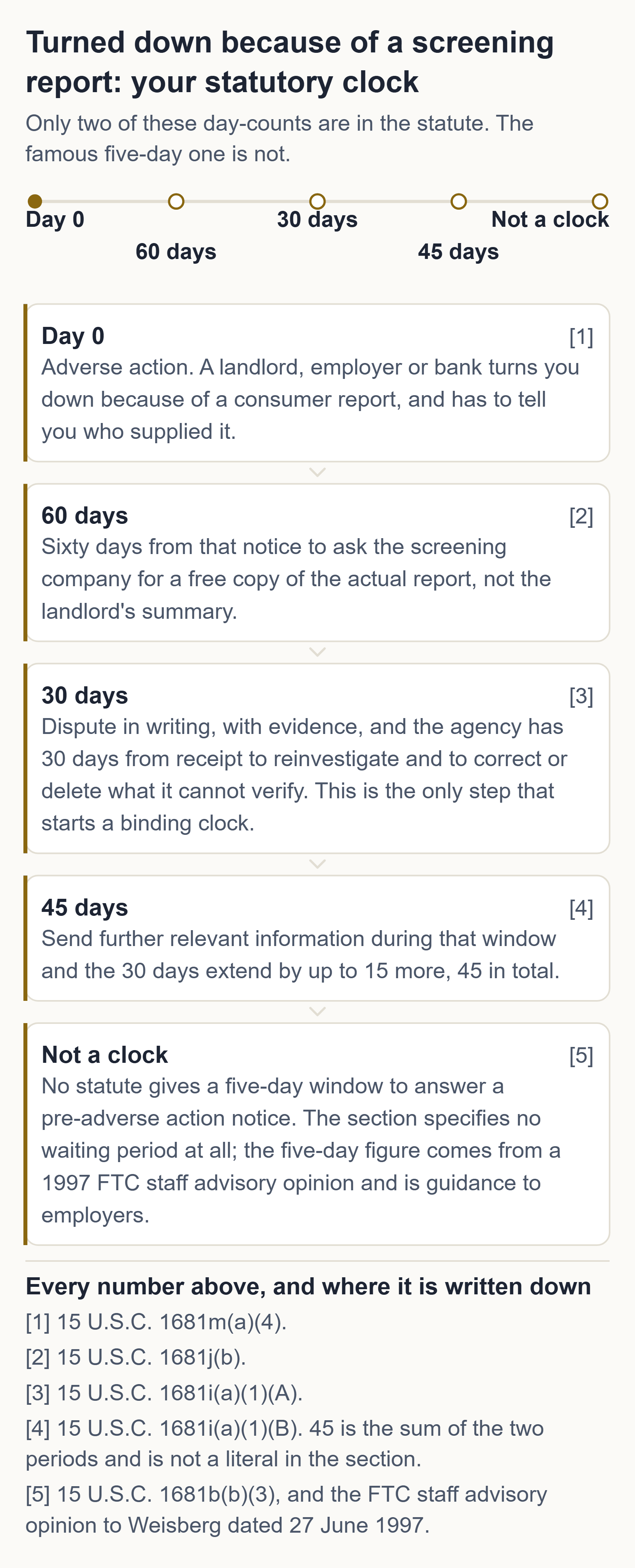
60 days to ask the screening company for a free copy of the report. 30 days for it to investigate once you dispute something. 45 days if you send more evidence while the investigation is running. They are short, they are fixed by federal law, and your adverse-action notice is required to point at the first of them — 15 U.S.C. §1681m(a)(4) — in a line that is easy to read past.
Put the date printed on your letter into the box below and you will get the actual calendar dates, worked out in your own browser. Nothing is sent to us and nothing is stored.
What to do tonight
- Find the date printed on the denial or adverse-action letter. Not the date you read it — the date on the page. That is day zero for everything below.
- Put it in the calculator and write the three dates on something you will see. The fridge, the back of the letter, your phone. People miss these deadlines because the sentence that mentions them sits in the small print of a letter nobody enjoys reading.
- Do not wait until the day before your deadline to ask for the report. Asking sooner moves the investigation date forward with you, because the 30-day clock starts when they receive your dispute, not when you were denied.
Missed the 60 days already? Read the card further down this page before you assume it is over — the right to dispute an error does not expire with the free-copy window.
Free, and it stays free. Nothing on this page sits behind a payment, an account, or a form — and we never ask for your name, your Social Security number, or your case. The tools here run entirely in your browser; we never see your answers.
You have your dates. The three letters come next, free to read and copy on this site. The dispute to the screening company, the request to the party still deciding, and the correction at the source of the bad data are written out in full, with the evidence each error type needs — free to read, no email asked for.
Read the three letters and the evidence checklist →
Written and answered by Andrew at Axion Labs — hello@getaxionlabs.com. Nothing on that page is for sale and no page on this site asks for an email address.What happens next, day by day
| When | What happens | Whose move |
|---|---|---|
| Day 0 | Adverse action — you are denied, or offered worse terms, because of a consumer report. You must be told this happened and told which company supplied the report. | The landlord, employer or bank |
| Days 0–60 | Request your free copy of that report from the screening company. Federal law says within 60 days of the adverse action. It is the actual report, not the landlord's summary. | You |
| Day X | Read it line by line against your own records and dispute every inaccurate item in writing, with copies of your evidence attached. The dispute is free. | You |
| +30 days | The screening company is generally required to investigate and to correct or delete what it cannot verify. Typically 30 days from receiving your dispute. | The screening company |
| +45 days | The same, extended, where you supplied additional information during the investigation. | The screening company |
| After | If they verify something you know is wrong: add a statement of dispute to your file, complain free to the CFPB at consumerfinance.gov (companies must respond), and to your state attorney general. | You |
Every step above is free. Anyone charging you to exercise these rights is selling you a letter you can write yourself.
Where these dates come from, so you can check them yourself rather than take our word for it. 15 U.S.C. §1681j is the free-copy section: it gives you the report without charge if you ask within 60 days of the adverse-action notice, and one free file disclosure every 12 months besides. 15 U.S.C. §1681i is the dispute section: the screening company gets 30 days to reinvestigate, extended by up to 15 further days — 45 days in total — if you send relevant information while it is running. 15 U.S.C. §1681m is the notice section: the adverse-action notice you were sent is required to include an indication of that 60-day period. Plain-English versions of the same rules: FTC, free credit reports and FTC, disputing errors on your credit report.
Missed the 60 days?
You are not out of options. The right to dispute an inaccurate item does not expire with the free-copy window, and you can still obtain your file — the free-after-adverse-action route is one way to get it, not the only way. Several screening companies provide a free disclosure once every twelve months regardless of any denial, and each company page here gives that company's own request route. Apply again elsewhere in the meantime, but pull the file: if the record blocking you is wrong, fixing it beats working around it.
Your three rights after a denial
- Be told who screened you — the landlord, employer, or bank must identify the company behind an adverse decision.
- The report itself, free — request your copy from the screening company (federal law: within 60 days of the denial).
- Dispute, and they must investigate — inaccurate items must be investigated (typically 30 days) and corrected or deleted if they can't be verified.
Full plain-English walkthrough on our home page.
What disputes can't do — and we won't help with
Disputes fix errors. They don't erase history that's true — accurate records survive investigation. If the record is real, what helps is settling and documenting it, second-chance programs, and time. We built this site for honest people hit by wrong records.
You have your own three dates in front of you, worked out from the date on your own letter, and you know which of them federal law fixes and which of them nobody can enforce.
A deadline is a strange kind of comfort, but it is the one I would want. It means this is finite. There is a date by which they have to answer you, and if they cannot prove the entry is yours they have to take it off. That is not a promise about your case — nobody honest can make you one — it is just the shape of the thing you are standing in front of, and it is smaller than it looks tonight.
— Andrew at Axion Labs. Write to me at hello@getaxionlabs.com if a page here is wrong or a step does not work. I read that inbox.General information based on FCRA consumer rights as explained in FTC and CFPB guidance, checked 2026-09-06. Not legal advice. Your denial letter and the agencies' official pages govern your case. Free help: your state attorney general, and complaints at consumerfinance.gov.
Thank you. That goes straight to the person who writes these pages.
That didn't send — try once more.