Who do I call about my background check — the screener, or the employer
They send you to each other. You have called both.
10,333 complaints about six specialty screening companies reached the federal regulator in twelve months, and not one of them was closed with any relief for the person who complained.
| What you want | Who can actually do it | What makes them |
|---|---|---|
| A copy of the report | The screening company | 15 U.S.C. §1681j(b) — free, within sixty days of the notice |
| An entry corrected or removed | The screening company | 15 U.S.C. §1681i(a)(1) — 30 days from receipt of your dispute, extended by up to 15 further days — 45 days in total — if you send further evidence |
| The name of the company that wrote it | Whoever took the decision | 15 U.S.C. §1681m(a)(3)(A) — the notice must carry the name, address and telephone number |
| Your account back, or the offer held open | The platform or employer | Nothing. No statutory clock. This is a request, which is why it has to be a good one |
| The underlying record fixed at its source | The court clerk, the licensing agency or the former employer | State record-correction procedure, which varies. The screening company will keep re-verifying against the same source until it changes |
Or let the Screening Dispute Kit write the letters.
“yes I talk to them I just go in circles with them they told me it was nothing they can do I have to reach out to the company that deactivated me then when I call them they tell me to call checkr it's no hope bro”
We hear this most. @Loveemamavempire, in the comments on the same YouTube video, August 6, 2022 — from someone in the same position.
Nobody has told you that they own different halves of your problem, and that only one of them is on a clock.
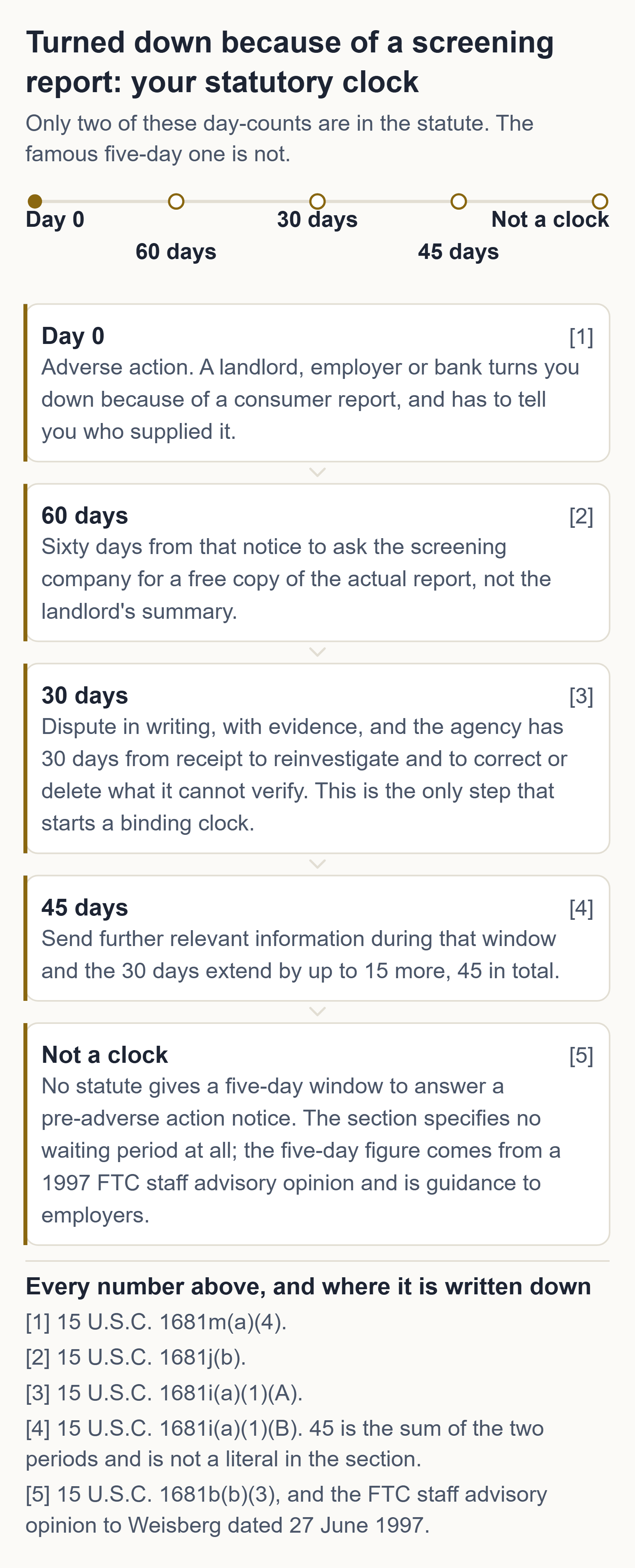
The screening company owes you the report within 60 days of the notice and owes you a reinvestigation in 30 days, extended by up to 15 further days — 45 days in total — if you send further evidence while it runs. The employer or platform owes you no deadline at all, and that is not an oversight, it is the shape of the statute.
Here is the one number that tells you which route is worth your evening. Over the same twelve months, on the same regulator, Equifax closed 46% of the complaints it closed with relief and TransUnion 42%. So for these six, a complaint to the regulator has not moved anything. The clock you can count on is the one in the statute.
The order to do it in →Free, and it stays free. Nothing on this page sits behind a payment, an account, or a form — and we never ask for your name, your Social Security number, or your case. The tools here run entirely in your browser; we never see your answers.
The two companies, and the one question that separates them
The circles people get stuck in come from asking one company for something only the other one can give. So here is the split, plainly. The screening company owns what the report says. It wrote it, it must give you a copy, and once you dispute an entry in writing it must reinvestigate and correct or delete whatever it cannot verify. The platform or employer owns the decision. It chose to act on the report, it can choose to wait, and it can choose to look again — and nothing in the Fair Credit Reporting Act puts a deadline on it doing any of that.
The honest limit of the fourth row
That row is the one people find hardest, and pretending otherwise would be the same trick this site exists to argue against. There is no letter that compels a platform to reinstate you. What there is: a dated dispute reference, evidence attached, and a short written request to hold the decision while the reinvestigation runs, sent to the party that is actually deciding. That is a materially better position than a phone call, and it is not a guarantee.
What actually resolved it, in the threads we read
We read eighty-nine Reddit threads and ninety YouTube comment threads for this lane on September 9, 2026. Two things resolved cases in them, and neither one was a cleverly worded letter: a re-run of the check after the underlying record was corrected at its source, and a different person at the platform looking at the same file. That is a thin sample and we are not going to dress it up as a study — six threads carried a resolution clearly enough to code at all. It points the same way the federal record does, from the other end.
The number, and what it is good for
Here is the one number that tells you which route is worth your evening. 10,333 complaints about six specialty screening companies reached the federal regulator in twelve months, and not one of them was closed with any relief for the person who complained. Over the same twelve months, on the same regulator, Equifax closed 46% of the complaints it closed with relief and TransUnion 42%. So for these six, a complaint to the regulator has not moved anything. The clock you can count on is the one in the statute.
So, in this order
- Get the name off your notice, then get the report. Free, from the screening company, within sixty days of the notice.
- Dispute in writing, to the screening company. This is the only step that starts a clock anybody has to answer.
- Ask the platform to hold the decision, separately and the same day, quoting the dispute reference. It owes you no deadline, which is exactly why the request has to arrive early and in writing.
Your three rights after a denial
- Be told who screened you — the landlord, employer, or bank must identify the company behind an adverse decision.
- The report itself, free — request your copy from the screening company (federal law: within 60 days of the denial).
- Dispute, and they must investigate — inaccurate items must be investigated (typically 30 days) and corrected or deleted if they can't be verified.
Full plain-English walkthrough on our home page.
What disputes can't do — and we won't help with
Disputes fix errors. They don't erase history that's true — accurate records survive investigation. If the record is real, what helps is settling and documenting it, second-chance programs, and time. We built this site for honest people hit by wrong records.
You know which of the two companies can do the thing you are asking for, and you know which of your two letters is the one that starts a clock.
The circle is not a conspiracy. Each company is telling you the truth about its own half and neither is telling you about the other half, and the result is a person calling two support lines for a week and getting nowhere. If you take one thing from this page: send both letters the same day, and expect the screening company's clock to be the only one that runs.
— Axion Labs. Write to us at hello@getaxionlabs.com if a page here is wrong or a step does not work. A person at Axion Labs reads that inbox.Next, on this site: How long this takes, and the three real dates · The three letters, written out in full · The route to every screening company we publish.
Questions people ask
These are the questions Google shows beside the searches this page is written for, in the words people type them. Each one is answered here, in a sentence, from the same sources the rest of the page uses — and where we hold no source, the answer says so.
Who do I call about something on my background check?
Call the company named on your notice, because the statute puts that name there (15 U.S.C. §1681m(a)(3)(A)) — but put the dispute in writing as well, because writing is what starts the 30 days to reinvestigate, extended by up to 15 further days — 45 days in total — if you send further evidence while it runs (15 U.S.C. §1681i(a)(1)), and a telephone call leaves you nothing you can show anyone afterwards.
How do I know if I passed my background check accurately?
There is no accuracy certificate and nobody issues one: the only way to see what was reported about you is to read the report, and after an adverse-action notice the screening company owes you a free copy within 60 days (15 U.S.C. §1681j(b)).
Who do I call if my background check failed?
Two companies, for two different things — the screening company for a copy and a correction, the employer or platform for the decision — and the table above is the split, row by row, with what makes each of them answerable.
How do I check if my background check went through?
Nobody is required to tell you it went through: the screening company answers to whoever ordered the report, and the only notice the law guarantees you is the one that arrives if the answer is no (15 U.S.C. §1681m(a)(3)(A)).
Questions as returned by Google's People Also Ask panel for this page's target searches, mobile, United States, pulled September 10, 2026. Answers are general information about the Fair Credit Reporting Act and about what each company publishes on its own pages; your own letter governs your case.
Thank you. That goes straight to the person who writes these pages.
That didn't send — try once more.