LexisNexis report errors — Risk Solutions
You have been told to contact LexisNexis Risk Solutions.
10,333 complaints about six specialty screening companies reached the federal regulator in twelve months, and not one of them was closed with any relief for the person who complained.
LexisNexis Risk Solutions: the actual route to a human
- Get your report / file a dispute
- https://consumer.risk.lexisnexis.com/help
- Request your free file copy
- https://consumer.risk.lexisnexis.com/request
- Telephone
- 1-888-497-0011 · Monday – Friday from 8:00 A.M. to 7:00 P.M. Eastern Time
- Consumer.Documents@LexisNexis.com
- By post
- LexisNexis Risk Solutions Consumer Center, P.O. Box 105108, Atlanta, GA 30348-5108
Read from LexisNexis Risk Solutions's own pages on September 9, 2026: consumer.risk.lexisnexis.com/ · consumer.risk.lexisnexis.com/consumer · consumer.risk.lexisnexis.com/help · consumer.risk.lexisnexis.com/request. If any of this has changed, write to hello@getaxionlabs.com and we will fix it the same day and re-date this block.
In LexisNexis Risk Solutions's own words, read on September 9, 2026: If you have questions or need to submit documents, you can do so via our LexisNexis Risk Solutions Reports Help page.
Send it a way you can prove. A portal upload gives you a confirmation screen — screenshot it the moment it appears. A letter sent by USPS Certified Mail with return receipt costs a few dollars and turns “I sent it” into a date-stamped fact. Do both if you can.
“My background check has someone else's record on it.”
We hear this most. a thread title on r/AttorneysHelp, read September 3, 2026 — not about this company, but about this kind of report.
Below is everything LexisNexis Risk Solutions actually publishes for a consumer — and everything it does not — each with the date we read it from LexisNexis Risk Solutions's own pages.
If a LexisNexis Risk Solutions report is why you were turned down, three dates matter and nothing else does. You have 60 days from the letter to ask LexisNexis Risk Solutions for a free copy of it. Once you dispute something in that copy, LexisNexis Risk Solutions has 30 days to investigate — 45 days if you send more evidence part-way through — and it has to correct or delete whatever it cannot verify.
Here is the one number that tells you which route is worth your evening. Over the same twelve months, on the same regulator, Equifax closed 46% of the complaints it closed with relief and TransUnion 42%. So a complaint to the regulator is not the thing that moves this. The clock is, and the clock is in the statute.
You are not alone. 70,462 complaint narratives in the federal CFPB database mention LexisNexis Risk Solutions, and 33% of them say the record was not the person's own. Both figures, and where they come from, are below.
Put your date in, get your deadlines →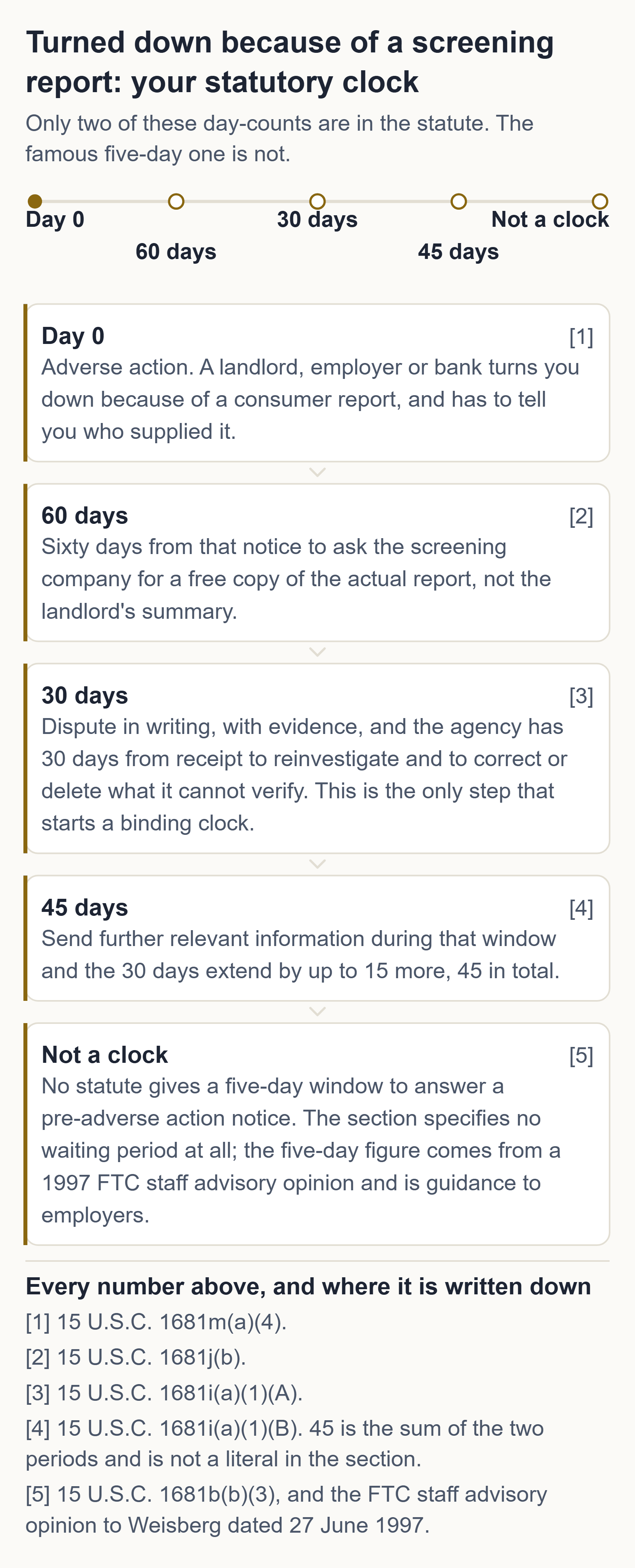
LexisNexis Risk Solutions phone number and customer service
What LexisNexis Risk Solutions publishes for a consumer, and what it does not
Telephone: 1-888-497-0011, Monday – Friday from 8:00 A.M. to 7:00 P.M. Eastern Time. Email: Consumer.Documents@LexisNexis.com. Read on September 9, 2026 from LexisNexis Risk Solutions's own pages, starting at consumer.risk.lexisnexis.com/.
The channel that starts the clock is the written one: consumer.risk.lexisnexis.com/help, or Consumer.Documents@LexisNexis.com, or by post to LexisNexis Risk Solutions Consumer Center, P.O. Box 105108, Atlanta, GA 30348-5108. A telephone call leaves you nothing to show; a dated written dispute gives LexisNexis Risk Solutions thirty days to investigate it.
If any of this has changed, write to hello@getaxionlabs.com and we will fix it the same day and re-date this block.
The LexisNexis consumer disclosure website, and what it gives you
It is consumer.risk.lexisnexis.com, and the name LexisNexis gives that site on its own page is LexisNexis Risk Solutions Consumer Disclosure
, read on September 22, 2026. The document behind it is the Consumer Disclosure Report, and LexisNexis says in its own words what is in it: real estate transaction and ownership data, lien, judgment, and bankruptcy records, professional license information, and historical addresses
(consumer.risk.lexisnexis.com/consumer, read September 22, 2026).
Three routes, all on that one site. Online, through the Online Request Form, after which, in LexisNexis's own words, you will receive a letter via U.S. Mail with additional information explaining how to access your report online
. By post, on the Printable Request Form, to the Consumer Center address in the next answer. Or by telephone on 1-866-897-8126 (consumer.risk.lexisnexis.com/consumer, read September 22, 2026).
It is also not a place to pay. If a site asked you for money to fetch your LexisNexis file, you were on the wrong site: LexisNexis writes on its own insurance data page that LexisNexis Risk Solutions will provide your file at no cost to you any time you make the request
(risk.lexisnexis.com/insurance/datause, read September 22, 2026).
Read at source on September 22, 2026 from the LexisNexis pages linked in this answer. If any of it has changed, write to hello@getaxionlabs.com and we will re-read and re-date it the same day.
Who is LexisNexis Consumer Center
It is not a separate company and it is not a debt collector. LexisNexis Risk Solutions Consumer Center is the name LexisNexis puts on its own consumer-facing team and on its post office box. Its help page is headed Contact Our Consumer Center Team
(consumer.risk.lexisnexis.com/help, read September 22, 2026), and the address it prints for a posted request is LexisNexis Risk Solutions Consumer Center, P.O. Box 105108, Atlanta, GA 30348-5108 (consumer.risk.lexisnexis.com/consumer, read September 22, 2026).
So a letter, a case number, or a URL and a PIN arriving from that name is the consumer side of LexisNexis Risk Solutions answering you, and it is the side that owes you the file. LexisNexis names which of its companies is the reporting one, in its own words: LexisNexis Risk Solutions Inc. is a consumer reporting agency as defined under the Fair Credit Reporting Act
(consumer.risk.lexisnexis.com, read September 22, 2026).
If the Consumer Center has written asking for documents before it will release your file, its help page names what it usually wants: a Utility Statement dated within the last 60 days
, a Social Security Card
, or a State-issued Drivers License or ID card
, uploaded through the form on that page with your case number (consumer.risk.lexisnexis.com/help, read September 22, 2026).
Read at source on September 22, 2026 from the LexisNexis pages linked in this answer. If any of it has changed, write to hello@getaxionlabs.com and we will re-read and re-date it the same day.
LexisNexis credit score: what it is, and what it is not
LexisNexis is not a credit bureau and publishes no credit score of its own. What it supplies to insurers is a different instrument, and LexisNexis draws that line itself: A credit-based insurance score, however, is a predictor of future insurance loss
, and a credit report may contain no negative factors from the standpoint of determining a consumer's eligibility for financial credit, but it may still indicate some degree of risk that an insurance loss will occur
(risk.lexisnexis.com/insurance/datause, read September 22, 2026).
Where credit does come into it, LexisNexis is passing it on rather than making it. In its own words it is a long-standing reseller of credit reports obtained from nationwide consumer reporting agencies
, and what goes back to the insurer can include the full credit report, a subset of the credit report or a credit-based insurance score
(the same LexisNexis insurance data page, read September 22, 2026).
So when a quote or a renewal moves and a LexisNexis score is named on the notice, there are two files to ask for and they sit in two different places: the Consumer Disclosure Report from the website above, and your credit file from Equifax, Experian and TransUnion. Ask for both. The one that priced you is the one with the reason codes on it, and the reason codes are the next answer.
Read at source on September 22, 2026 from the LexisNexis pages linked in this answer. If any of it has changed, write to hello@getaxionlabs.com and we will re-read and re-date it the same day.
LexisNexis insurance score reason codes, and what they mean
A reason code is the short explanation that travels with the score. LexisNexis's own definition: A reason code is used by insurers and consumers to better understand the credit attributes that inform a credit-based insurance score
, and on how many of them you get, The reason codes will identify up to four principal factors that influenced the score
(risk.lexisnexis.com/insurance/datause, read September 22, 2026).
LexisNexis publishes the list. The same page says it makes available a list of reason codes and their meaning
, and tells you what to do with the code printed on your letter: If you received a notice from your insurance company that shows the LexisNexis Attract score was used and you have a reason code associated with your score, you can select the reason code number at the link below and you will receive the expanded explanation for what the reason code means
. The document that link opens is the LexisNexis Attract Reason Codes list, reached from that page (read September 22, 2026).
One limit before you write to anybody, in LexisNexis's own words: LexisNexis Risk Solutions is not an insurance company; LexisNexis Risk Solutions does not make underwriting decisions or determine insurance underwriting guidelines
(the same LexisNexis insurance data page, read September 22, 2026). So the reason code tells you what moved the score, your insurer tells you what it did with it, and the file underneath both is the thing you can dispute. Ask for the file first.
Read at source on September 22, 2026 from the LexisNexis pages linked in this answer. If any of it has changed, write to hello@getaxionlabs.com and we will re-read and re-date it the same day.
You now have LexisNexis Risk Solutions's address, the channel that starts the clock, and the date each of the three clocks runs out — and you know exactly what LexisNexis Risk Solutions does not publish. Nothing on this page is for sale, and nothing on this site is: your report and your dispute are free by law.
What to do tonight
- Get the report. Request your free “Full File Disclosure” directly at consumer.risk.lexisnexis.com — it shows everything LexisNexis holds on you. After a denial the copy is free, and you never have to pay anyone else to fetch it for you.
- Read it line by line against your own records. Dates, addresses, middle names, case numbers, amounts. The errors that get fixed are the ones you can point at, not the ones you can feel.
- Write the dispute the same day the report lands. Say which entry is wrong, say why in one sentence, attach copies — never originals — and send it a way you can prove. The clock starts when LexisNexis Risk Solutions receives it, not when you were denied.
All of that is free apart from postage if you post it. There is a copy-paste letter on every situation page, and the deadline calculator below turns your letter's date into real dates.
Free, and it stays free. Nothing here sits behind a payment, an account, or a form — and we never ask for your name, your Social Security number, or your case. The tools here run entirely in your browser; we never see your answers.
One of the largest consumer data brokers in the US. Its files feed tenant-screening, insurance, employment, and banking decisions across the industry — many denials trace back to a LexisNexis record even when the screening company that scored you has a different name.
CFPB published complaint narratives, 2011 - August 14, 2026. The CFPB ceased discretionary publication of complaint narratives on August 14, 2026, so every narrative-derived count on this site is a closed series and will not change. Complaint intake continues, and the per-company outcome table runs on all complaints and is current.
CFPB Consumer Complaint Database, checked 2026-09-06. Rows mentioning LexisNexis Risk Solutions and the pattern's keywords — an indicative breakdown, not a census, and not an official per-company tally.
33% of complaint mentions say “that record isn't mine” — the mixed-file problem. If LexisNexis Risk Solutions shows you someone else's record, that is exactly what the free dispute process exists for.
What people complain about
Rows mentioning LexisNexis Risk Solutions and the pattern's keywords — an indicative breakdown, not a census.
What happened to people who complained about LexisNexis Risk Solutions to the federal regulator
LEXISNEXISThat is 25% of the complaints that were closed.
And the same instrument, read across the whole lane: 10,333 complaints about six specialty screening companies reached the federal regulator in twelve months, and not one of them was closed with any relief for the person who complained. Over the same twelve months, on the same regulator, Equifax closed 46% of the complaints it closed with relief and TransUnion 42%. So a complaint to the regulator is not the thing that moves this. The clock is, and the clock is in the statute.
"Closed with explanation" is a response category, not a finding that the consumer was wrong. Relief rates here are complaints closed with relief divided by complaints closed; complaints still in progress and untimely responses are not closures.
CFPB Consumer Complaint Database, company_response aggregation on the CFPB's own case-sensitive company= filter, 12 months to 2026-09-08, checked September 9, 2026. Re-run it yourself: https://www.consumerfinance.gov/data-research/consumer-complaints/search/api/v1/?company=<EXACT CFPB STRING>&date_received_min=2025-09-08&date_received_max=2026-09-08&size=0&no_aggs=false — the endpoint is the CFPB's own complaint search API, and the one part you substitute is the company string above.
Get your file — free
Request your free “Full File Disclosure” directly at consumer.risk.lexisnexis.com — it shows everything LexisNexis holds on you. After any adverse action you're entitled to a free copy under the FCRA — you never need to pay a third party to obtain it. The CFPB also keeps the authoritative directory of consumer reporting companies and their contact routes at consumerfinance.gov.
What happens next, day by day
| When | What happens | Whose move |
|---|---|---|
| Day 0 | Adverse action — you are denied, or offered worse terms, because of a consumer report. You must be told this happened and told which company supplied the report. | The landlord, employer or bank |
| Days 0–60 | Request your free copy of that report from the screening company. Federal law says within 60 days of the adverse action. It is the actual report, not the landlord's summary. | You |
| Day X | Read it line by line against your own records and dispute every inaccurate item in writing, with copies of your evidence attached. The dispute is free. | You |
| +30 days | The screening company is generally required to investigate and to correct or delete what it cannot verify. Typically 30 days from receiving your dispute. | The screening company |
| +45 days | The same, extended, where you supplied additional information during the investigation. | The screening company |
| After | If they verify something you know is wrong: add a statement of dispute to your file, complain free to the CFPB at consumerfinance.gov (companies must respond), and to your state attorney general. | You |
Every step above is free. Anyone charging you to exercise these rights is selling you a letter you can write yourself.
Where these dates come from, so you can check them yourself rather than take our word for it. 15 U.S.C. §1681j is the free-copy section: it gives you the report without charge if you ask within 60 days of the adverse-action notice, and one free file disclosure every 12 months besides. 15 U.S.C. §1681i is the dispute section: the screening company gets 30 days to reinvestigate, extended by up to 15 further days — 45 days in total — if you send relevant information while it is running. 15 U.S.C. §1681m is the notice section: the adverse-action notice you were sent is required to include an indication of that 60-day period. Plain-English versions of the same rules: FTC, free credit reports and FTC, disputing errors on your credit report.
Your FCRA deadlines, from your own date
The clocks are fixed: 60 days from the adverse action to request your free report copy, then 30 days for the screening company to conclude a dispute investigation — 45 days if you send additional information while it is running. Put the date on your denial letter in and get the actual dates.
Runs entirely in your browser — the date is never sent to us and never stored. General information based on FCRA consumer rights as explained in FTC and CFPB guidance, checked 2026-09-06. Your denial letter and the agencies' own pages govern your case.
If this is the company on your letter
These are the situations people describe most often with LexisNexis Risk Solutions. Each one has the evidence that wins it, a first move, and copy-paste letters — all free:
Related, on this site
Waiting on a check right now? How long a background check takes, and the three dates that are actually in the statute. Which of the two companies can fix which thing.
Stopped by one of these? Uber · DoorDash · Instacart · Amazon · Walmart · FedEx — each one carries the route to whichever screener is named on your own notice.
Your three rights after a denial
- Be told who screened you — the landlord, employer, or bank must identify the company behind an adverse decision.
- The report itself, free — request your copy from the screening company (federal law: within 60 days of the denial).
- Dispute, and they must investigate — inaccurate items must be investigated (typically 30 days) and corrected or deleted if they can't be verified.
Full plain-English walkthrough on our home page.
What disputes can't do — and we won't help with
Disputes fix errors. They don't erase history that's true — accurate records survive investigation. If the record is real, what helps is settling and documenting it, second-chance programs, and time. We built this site for honest people hit by wrong records.
Questions
Who is LexisNexis Risk Solutions and why do they have my information?
One of the largest consumer data brokers in the US. Its files feed tenant-screening, insurance, employment, and banking decisions across the industry — many denials trace back to a LexisNexis record even when the screening company that scored you has a different name. It is a consumer reporting company under the Fair Credit Reporting Act, which means the file it holds on you is yours to see and yours to dispute.
How many complaints does LexisNexis Risk Solutions get?
70,462 complaint mentions in the federal CFPB Consumer Complaint Database as of 2026-09-06. The most-reported problems are That record isn't mine (mixed file / identity mix-up) (23,109 rows), Dispute ignored or mishandled (151 rows), Cost someone a job (143 rows). These are text mentions in complaint narratives, not official per-company tallies — a relative signal, not a scoreboard.
What do people complain about most with LexisNexis Risk Solutions?
That record isn't mine (mixed file / identity mix-up), at 23,109 complaint rows — 33% of all mentions of LexisNexis Risk Solutions. Read that as where people report problems, not as a measure of how often problems occur.
How do I get my LexisNexis Risk Solutions report for free?
Request your free “Full File Disclosure” directly at consumer.risk.lexisnexis.com — it shows everything LexisNexis holds on you. After any adverse action you are entitled to a free copy under the Fair Credit Reporting Act — federal law says request it within 60 days — and you never need to pay a third party to obtain it.
How long does a LexisNexis Risk Solutions dispute take?
Typically 30 days from when LexisNexis Risk Solutions receives your written dispute, or 45 days where you supply additional information while the investigation is running. It must correct or delete what it cannot verify, and the investigation is free.
What if LexisNexis Risk Solutions says the record is accurate?
Then a dispute will not remove it, and this site will not pretend otherwise. Disputes fix errors: records that are not yours, debts you paid, cases that were dismissed. If you know the record is wrong and it was verified anyway, you can add a statement of dispute to your file, complain free to the CFPB at consumerfinance.gov — companies are required to respond — and to your state attorney general. If the record is genuinely accurate, what helps is settling and documenting it, second-chance rental and hiring programs, and time.
Questions people ask
These are the questions Google shows beside the searches this page is written for, in the words people type them. Each one is answered here, in a sentence, from the same sources the rest of the page uses — and where we hold no source, the answer says so.
How do I remove my information from LexisNexis?
You can dispute what is wrong and you can ask for a full file disclosure of what LexisNexis holds — LexisNexis's own consumer help page carries both routes, read on September 9, 2026 — but a dispute removes an entry the company cannot verify (15 U.S.C. §1681i(a)(1)), not your file.
How do I request a consumer risk report from LexisNexis?
Request it through LexisNexis's own consumer request page, the route read from LexisNexis's own pages read on September 9, 2026; after an adverse action the copy is free within 60 days of the notice (15 U.S.C. §1681j(b)).
Can a LexisNexis report affect insurance rates?
LexisNexis holds insurance claims histories and insurers use them, which is what the product is in the directory this site publishes — and if an insurance decision went against you because of a report, the notice has to name the company that supplied it (15 U.S.C. §1681m(a)(3)(A)) and that company owes you a free copy of it within 60 days of the notice (15 U.S.C. §1681j(b)).
What is LexisNexis and is it legit?
LexisNexis Risk Solutions is one of the largest consumer data brokers in the US and a consumer reporting agency with published request and dispute routes, read on September 9, 2026 — and the federal regulator attributes 31,968 complaints to it, of which 7,938 were closed with relief for the person who complained.
Is LexisNexis used for background checks?
Yes: LexisNexis files feed tenant-screening, insurance, employment and banking decisions, and our full-text scan of the CFPB complaint database found 70,462 complaint narratives mentioning LexisNexis.
How much does a LexisNexis report cost?
Nothing, in the case that brings people to this page: after an adverse action the copy is free within 60 days of the notice (15 U.S.C. §1681j(b)), and what LexisNexis's own consumer pages carry, read on September 9, 2026, is a full file disclosure request route.
What shows up on LexisNexis background check?
Insurance claims histories, evictions and public records are what the LexisNexis file is built from, as the product is described in the directory this site publishes — what is in yours is in the full file disclosure you can request at its consumer request page, free within 60 days of an adverse-action notice (15 U.S.C. §1681j(b)).
CFPB published complaint narratives, 2011 - August 14, 2026. The CFPB ceased discretionary publication of complaint narratives on August 14, 2026, so every narrative-derived count on this site is a closed series and will not change. Complaint intake continues, and the per-company outcome table runs on all complaints and is current.
Questions as returned by Google's People Also Ask panel for this page's target searches, mobile, United States, pulled September 10, 2026. Answers are general information about the Fair Credit Reporting Act and about what each company publishes on its own pages; your own letter governs your case.
The hardest part of this is almost never the letter. It is the hour when you cannot find a phone number, the portal will not let you in, and the people who made the decision point at LexisNexis Risk Solutions while LexisNexis Risk Solutions points back at them. Write anyway, and write to both. A dated letter that somebody has to answer beats an hour on hold that leaves you nothing to show, and it is the only thing that starts a clock the law will hold them to.
— Andrew at Axion Labs. Write to me at hello@getaxionlabs.com if a page here is wrong or a step does not work. I read that inbox.Counts are complaint rows in the federal CFPB Consumer Complaint Database whose text mentions the company (case-insensitive scan of 28.4 million rows, 2026-09-06). Text mentions, not official per-company tallies — treat them as a relative signal of where consumers report problems. Source: files.consumerfinance.gov bulk data. Company descriptions checked August 2026. This is general information, not legal advice.
Thank you. That goes straight to the person who writes these pages.
That didn't send — try once more.